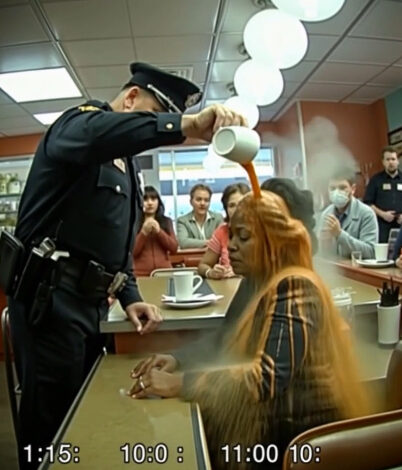
As Clara left the diner, whispers and murmurs spread through the crowd, a mixture of shock and disapproval. Some patrons rushed after her, offering assistance and apologizing for the town’s treatment, but Clara, composed and gracious, assured them she was fine, her attention elsewhere.
Detective John Harris remained rooted in place, emotions flickering across his face. Though he attempted to maintain an air of indifference, a growing sense of unease gnawed at him. The moment of prejudice that had guided his actions now felt increasingly indefensible.
As hours passed, Harris’s conscience weighed heavily. The memory of Clara’s dignified retreat refused to fade. It wasn’t until he returned to the station that the full gravity of his actions struck him.
Captain Elaine Richards, known for her unwavering integrity, summoned Harris to her office. Her expression mixed disappointment with anger. “John,” she began, “do you know who that woman is?”
Harris shook his head, unsure of what he was about to hear.
“Clara Williams,” Captain Richards continued, “is the widow of Senator Robert Williams, a man who devoted his life to civil rights in this state. She’s a respected pillar of the community.”
The revelation hit Harris like a physical blow. His knees buckled, and he sank into a chair, the reality of his mistake overwhelming him. He had not only wronged an innocent woman but also disrespected the legacy of a man who fought tirelessly for justice.



News of the diner incident quickly spread, reaching community leaders and activists. The town buzzed with conversation, and calls for accountability grew louder. Protests were organized, demanding that Harris answer for his actions. For Harris, the following days became a period of deep reflection. He confronted long-ignored biases and began a painful journey of self-awareness. Eventually, he reached out to Clara to apologize sincerely, understanding that words alone could not undo the harm but could be a first step toward making amends. Clara met with Harris with measured grace. Forgiveness was not immediate; it had to be earned. She encouraged…
News of the diner incident quickly spread, reaching community leaders and activists. The town buzzed with conversation, and calls for accountability grew louder. Protests were organized, demanding that Harris answer for his actions.
For Harris, the following days became a period of deep reflection. He confronted long-ignored biases and began a painful journey of self-awareness. Eventually, he reached out to Clara to apologize sincerely, understanding that words alone could not undo the harm but could be a first step toward making amends.
Clara met with Harris with measured grace. Forgiveness was not immediate; it had to be earned. She encouraged him to examine the roots of his prejudice and to take meaningful steps toward personal growth.
Through this process, Harris transformed. He became an advocate for racial sensitivity training within the police department, using his experience to educate others. Clara’s strength and dignity had not only changed him but also sparked vital conversations throughout the town about race, justice, and humanity.
Ultimately, the incident became a catalyst for positive change, proving that even in the darkest moments, there is potential for growth and understanding when one is willing to learn and listen.



Leave a Reply